Play Cat
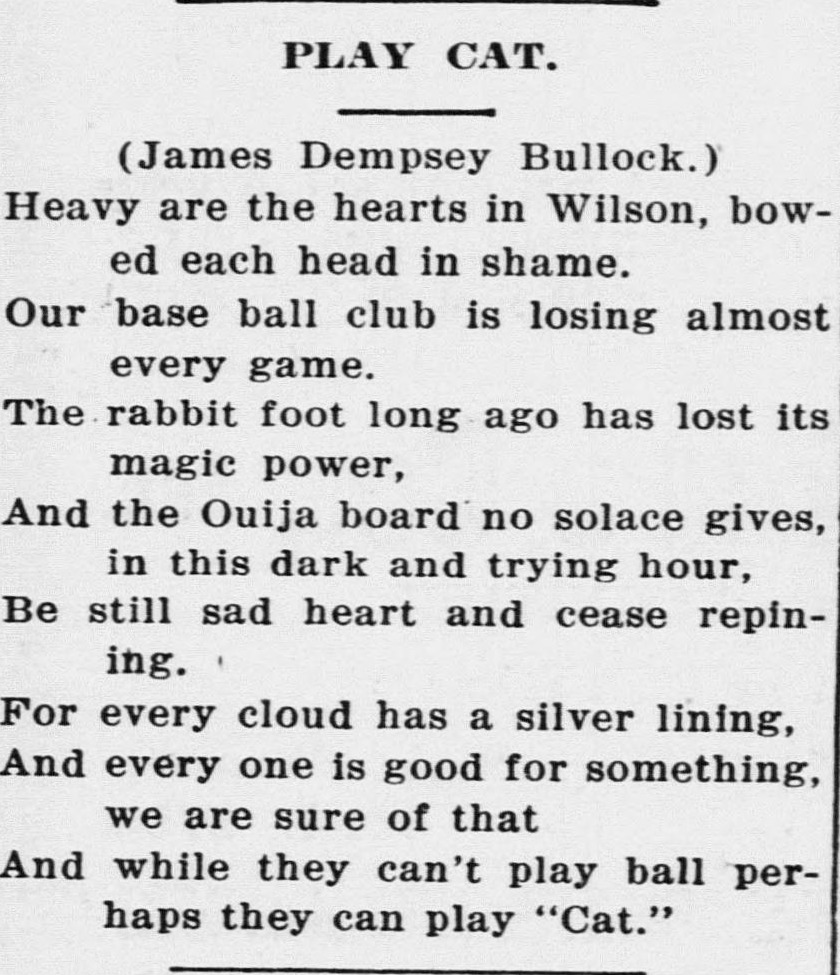
The Daily Times, 1921. View the original
Wilson, North Carolina, 1921. The ball club is losing, the rabbit foot has failed, the Ouija board offers no solace, and James Dempsey Bullock delivers the town's grief in verse with a dagger in the last line.
Wilson’s ball club is losing almost every game, and the town has run through its entire spiritual inventory. James Dempsey Bullock files the report in verse.
“Heavy are the hearts in Wilson, bow- / ed each head in shame. / Our base ball club is losing almost / every game.”
The remedies have been tried in order. “The rabbit foot long ago has lost its / magic power, / And the Ouija board no solace gives, / in this dark and trying hour.” A town that has consulted both the rabbit’s foot and the Ouija board about its ball club is a town this establishment recognizes on sight. Aberdeen could have warned them about depending on the rabbit’s foot.
Then Bullock turns pastoral. Be still, sad heart. Every cloud has a silver lining. “And every one is good for something, / we are sure of that.” You can feel the arm going around the shoulder. You cannot yet feel the hand closing on the collar.
“And while they can’t play ball per- / haps they can play ‘Cat.’”
Cat, for anyone who missed a nineteenth-century childhood, was the schoolyard game base ball grew out of, the one-old-cat and two-old-cat that boys played when there weren’t enough of them for sides. Bullock is suggesting, in metered verse, in the newspaper, that the town nine go back to the beginner game.
Every one is good for something. We are sure of that. The poem holds the town’s hand all the way to the trapdoor, and this establishment has read the last line eleven times and laughed at every one of them.
| Place | Wilson, North Carolina |
|---|---|
| Year | 1921 |
| Newspaper | The Daily Times |
| Posted | |
| Tags |