How Great Men Play the Game: Chief Bender
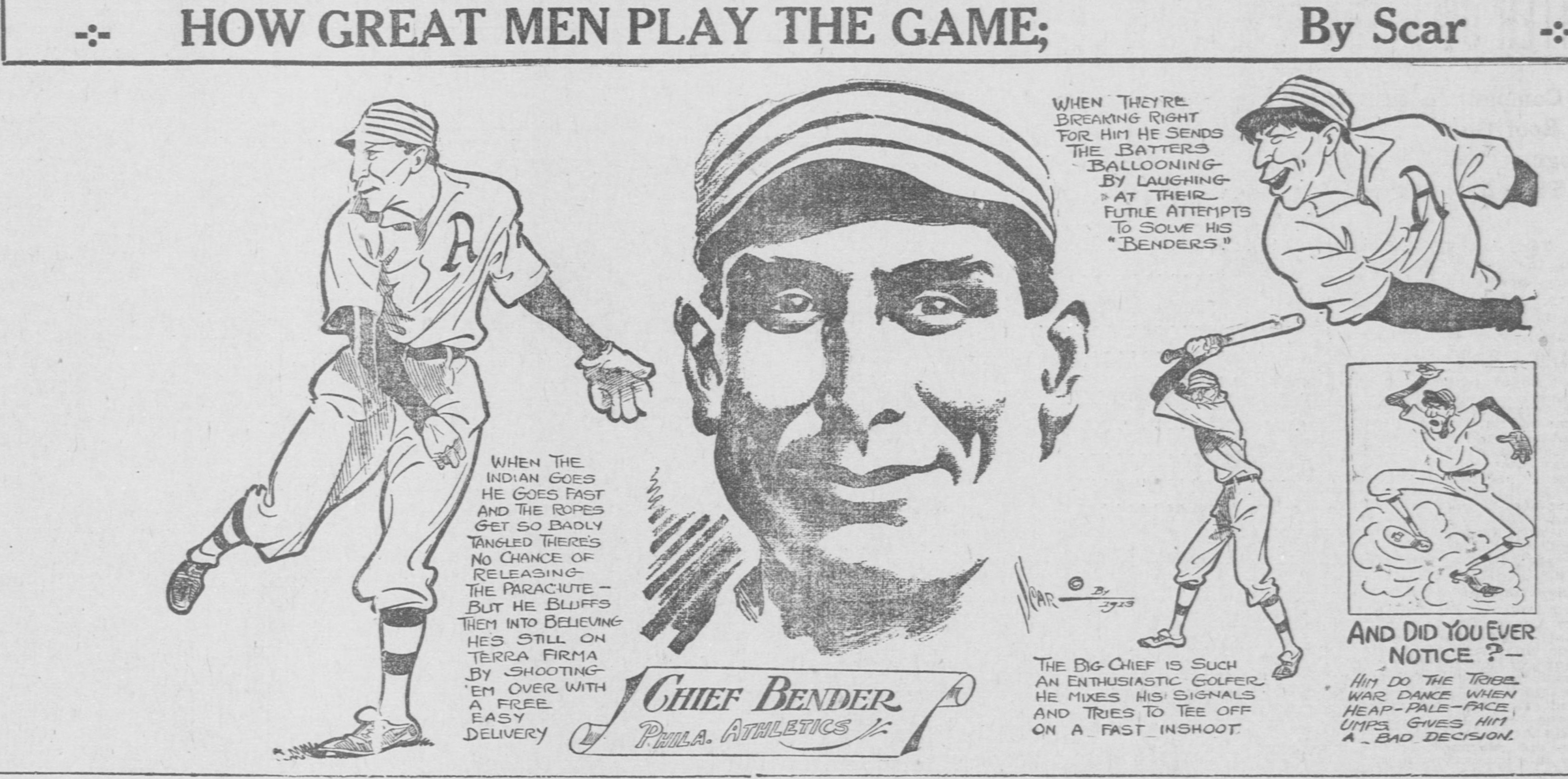
El Paso Herald, 1913. View the original
Scar takes up Chief Bender of the Athletics in August 1913: he bluffs baserunners with a free easy delivery, sends batters ballooning by laughing at their futile attempts to solve his benders, and swings at inshoots like an enthusiastic golfer.
This installment’s banner reads “Chief Bender, Phila. Athletics,” which is what the sporting press called Charles Albert Bender his whole career. He was Ojibwe, the best big-game pitcher Connie Mack had, and in 1913 on his way to 21 wins, and the papers almost never let readers forget the first fact. Scar’s captions call him “the Indian” and “the big Chief” straight through, and the corner box reaches for the crudest gag on the shelf. That was the standard issue cartooning of 1913, and it says a good deal more about 1913 than about Bender.
The baseball inside the panel is real enough. On holding runners: “when the Indian goes he goes fast and the ropes get so badly tangled there’s no chance of releasing the parachute - but he bluffs them into believing he’s still on terra firma by shooting ‘em over with a free easy delivery.” On the pitch that carried his name: “when they’re breaking right for him he sends the batters ballooning by laughing at their futile attempts to solve his ‘benders.’” A man whose surname was already a synonym for the curveball was, in a sense, born scouted.
At the plate Scar finds the weakness: “the big chief is such an enthusiastic golfer, he mixes his signals and tries to tee off on a fast inshoot,” drawn with a full golfer’s follow-through. Bender took the mound that October in the World’s Series, as he usually did, and won two games. The batters kept ballooning either way.
| Place | El Paso, Texas |
|---|---|
| Year | 1913 |
| Newspaper | El Paso Herald |
| Posted | |
| Tags |