Guaranteed base ball supplies
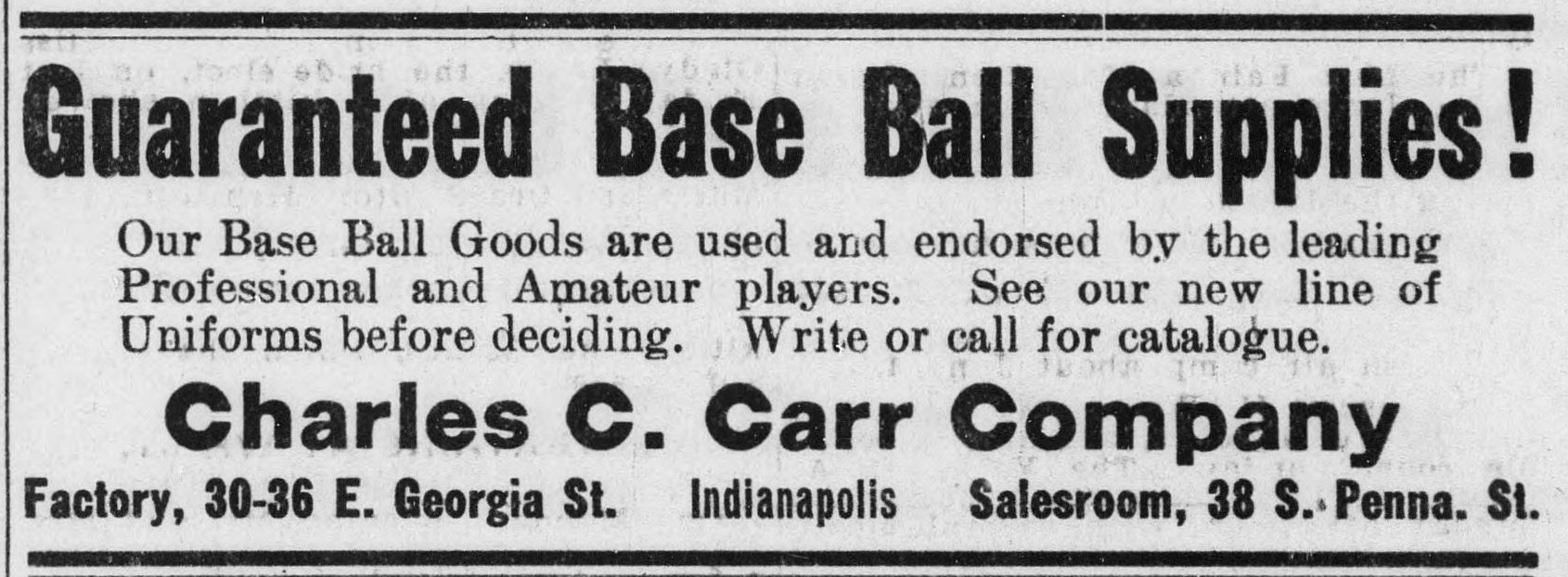
The Freeman, 1914. View the original
A big league first baseman's supply house promises guaranteed base ball goods in the Freeman of May 1914. Two things make the ad worth keeping: the Charles C. Carr on the letterhead was playing first for the Federal League's Indianapolis Hoosiers that very spring, and he chose to say so in a Black newspaper. The leagues Carr played in drew a color line. His salesroom did not.
The Freeman of May 23, 1914 carried a plainspoken pitch from an Indianapolis maker: “Guaranteed Base Ball Supplies! Our Base Ball Goods are used and endorsed by the leading Professional and Amateur players. See our new line of Uniforms before deciding. Write or call for catalogue.” The signature: “Charles C. Carr Company. Factory, 30-36 E. Georgia St. Salesroom, 38 S. Penna. St.”
The name is worth a second look. Charlie Carr was a big league first baseman, Senators, Athletics, Tigers, Naps and Reds across the years, and later the player-manager who led the Indianapolis Indians to the 1908 American Association pennant. He ran a sporting goods manufacturing business on the side, moved it from Cleveland to Indianapolis in 1908, and supplied baseballs to minor leagues. In the spring of 1914, when this ad ran, a 37 year old Carr was playing first base across town for the Indianapolis Hoosiers of the outlaw Federal League, on his way to a .295 season. A guarantee is easier to make when you can test the goods at your day job.
Now look where he made it. The Freeman announced itself at the top of every page as “An Illustrated Colored Newspaper,” and its sporting columns were where Black baseball did business, the kind of page where a club could publish a challenge to all comers and hope it reached the eye of some enterprising manager. That is the readership Carr bought space in front of, factory and salesroom addresses included, come see the uniforms before deciding. The leagues Carr spent his career in drew the color line at the clubhouse door. His catalogue was open to whoever wrote or called.
| Place | Indianapolis, Indiana |
|---|---|
| Year | 1914 |
| Newspaper | The Freeman |
| Posted | |
| Tags |