Chicago's Girls' Baseball Loop Offers Good Pay, Clean Fun
Evening Star, 1947. View the original
May 1947: Chicago's other girls' league opens its season, and the AP finds big business. Six teams, four manicured parks, television picking up the trail, Red Grange installed as commissioner and a 7,500 dollar dressing room with theatrical mirrors. One catch the story never mentions: the National Girls' Baseball League pitched underhand. It was softball wearing baseball's name.
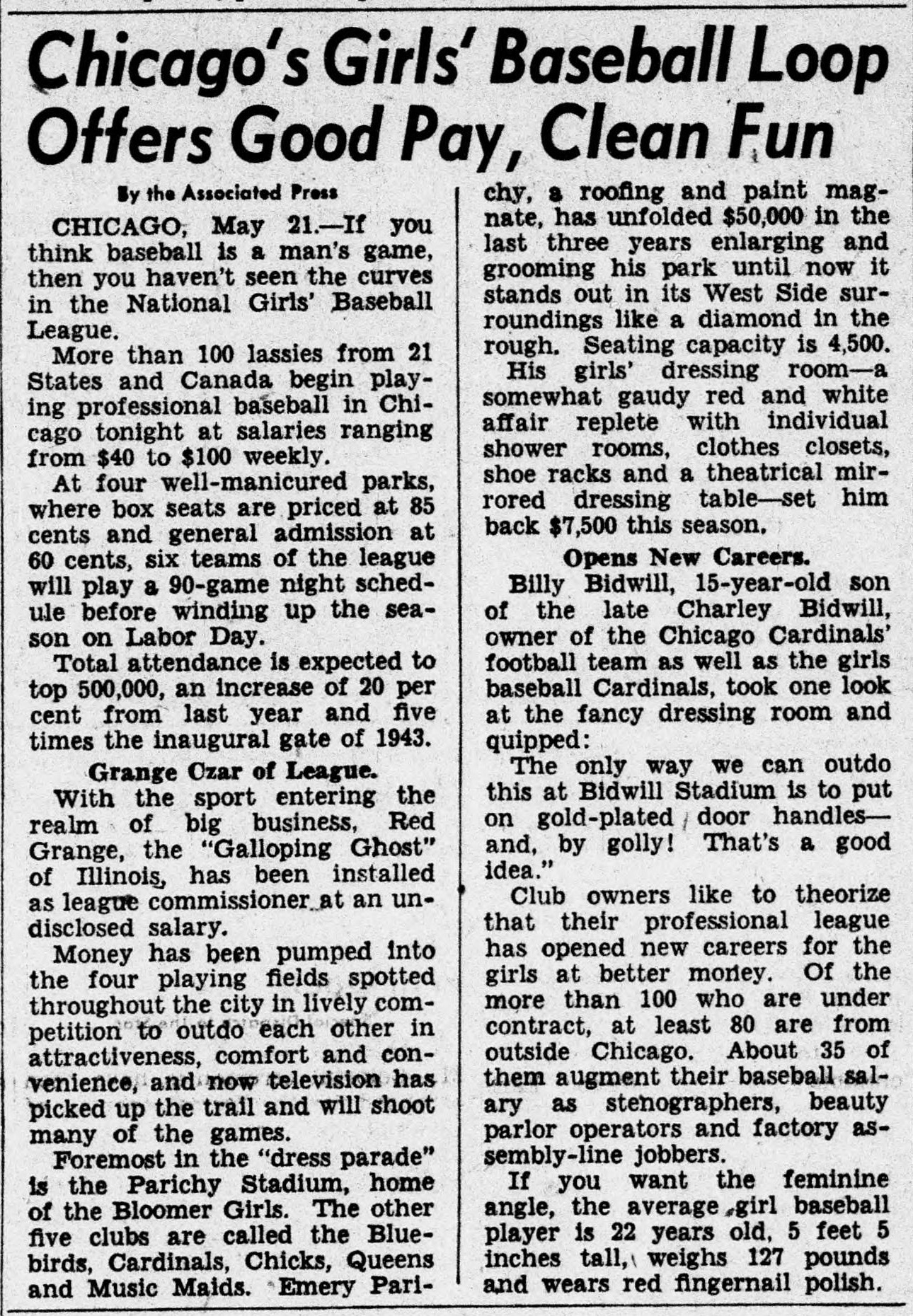
“If you think baseball is a man’s game, then you haven’t seen the curves in the National Girls’ Baseball League.” So began an Associated Press dispatch from Chicago that the Evening Star ran on May 21, 1947, and with that pun out of its system the story got down to business, which was considerable.
“More than 100 lassies from 21 States and Canada begin playing professional baseball in Chicago tonight at salaries ranging from $40 to $100 weekly. At four well-manicured parks, where box seats are priced at 85 cents and general admission at 60 cents, six teams of the league will play a 90-game night schedule before winding up the season on Labor Day.” Expected attendance: 500,000, “five times the inaugural gate of 1943.” Television “has picked up the trail and will shoot many of the games.” And presiding over it all, a name from another sport entirely: “Red Grange, the ‘Galloping Ghost’ of Illinois, has been installed as league commissioner, at an undisclosed salary.”
Here is what the story never quite says: this is not the league we’ve been following all month. The National Girls’ Baseball League was Chicago’s homegrown rival to the All-Americans, six teams named the Bloomer Girls, Bluebirds, Cardinals, Chicks, Queens and Music Maids, and it played underhand softball from its first pitch to its last. While the All-American league was renaming itself toward baseball and changing its rules to match, the National simply took the word baseball and kept playing softball underneath it. Two leagues, ten years, and the two words swapped back and forth between them until nobody could say which was which. If you have ever been confused about girls’ baseball versus girls’ softball in this era, be comforted: the era was confused on purpose.
The color is wonderful. Emery Parichy, “a roofing and paint magnate, has unfolded $50,000 in the last three years enlarging and grooming his park until now it stands out in its West Side surroundings like a diamond in the rough.” His girls’ dressing room, “a somewhat gaudy red and white affair replete with individual shower rooms, clothes closets, shoe racks and a theatrical mirrored dressing table,” cost $7,500, which moved Billy Bidwill, 15-year-old heir to the football Cardinals, to quip: “The only way we can outdo this at Bidwill Stadium is to put on gold-plated door handles—and, by golly! That’s a good idea.”
The closer is a census, offered “if you want the feminine angle”: height, weight, age and fingernail polish, measured out as if that were the roster. The numbers that actually matter sit a paragraph up. More than 100 women under contract, at least 80 recruited from outside Chicago, half a million paying customers expected, and about 35 players working second jobs as “stenographers, beauty parlor operators and factory assembly-line jobbers” on top of a 90-game schedule. Good pay, clean fun, and an asterisk on the word baseball the size of Parichy Stadium.
| Team | National Girls Baseball League |
|---|---|
| Place | Chicago, Illinois |
| Year | 1947 |
| Newspaper | Evening Star |
| Posted | |
| Tags |