Trailbreakers In Girls Baseball Arrive For Practice
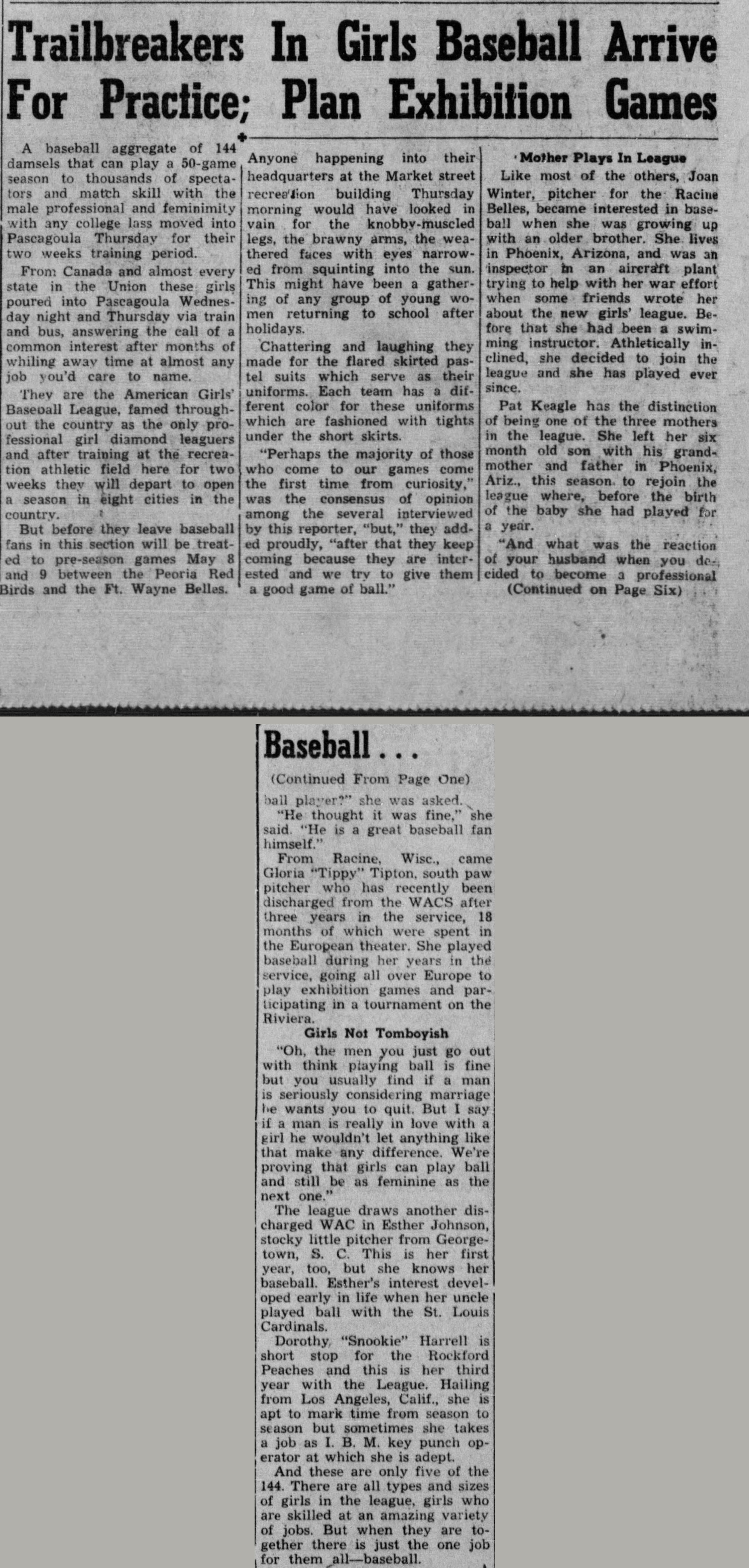
The Chronicle-Star, 1946. View the original
April 1946: the All-American Girls league brings spring training to Pascagoula, Mississippi, and the Chronicle-Star puts all 144 damsels on the front page. Anyone looking for knobby-muscled legs and weathered faces looked in vain. Instead: a WAC veteran who pitched her way across Europe, three mothers, and a firm word on men who want you to quit.
In the spring of 1946 the All-American Girls league took its training camp south, and on April 26 the Chronicle-Star of Pascagoula, Mississippi put the whole thing on the front page: “Trailbreakers In Girls Baseball Arrive For Practice; Plan Exhibition Games.”
The paper counted “a baseball aggregate of 144 damsels” arriving “from Canada and almost every state in the Union… via train and bus, answering the call of a common interest after months of whiling away time at almost any job you’d care to name.” They were, it explained, “the American Girls’ Baseball League, famed throughout the country as the only professional girl diamond leaguers,” in town for two weeks before opening “a season in eight cities.” Locals would get exhibitions May 8 and 9 between teams the paper renders as “the Peoria Red Birds and the Ft. Wayne Belles,” which the league knew as the Redwings and the Daisies. Close enough for the front page.
The reporter went looking for stereotypes and reported honestly on not finding them: “Anyone happening into their headquarters at the Market street recreation building Thursday morning would have looked in vain for the knobby-muscled legs, the brawny arms, the weathered faces with eyes narrowed from squinting into the sun. This might have been a gathering of any group of young women returning to school after holidays.” The players had heard it all before. “Perhaps the majority of those who come to our games come the first time from curiosity,” they said, “but after that they keep coming because they are interested and we try to give them a good game of ball.”
The people in this story are the good part. Joan Winter, Racine pitcher, learned the game growing up with an older brother and left an aircraft plant to join. Gloria “Tippy” Tipton, southpaw, came “recently… discharged from the WACS after three years in the service, 18 months of which were spent in the European theater,” where she “played baseball during her years in the service, going all over Europe to play exhibition games and participating in a tournament on the Riviera.” Pat Keagle was “one of the three mothers in the league.” And under the subhead “Girls Not Tomboyish,” an unnamed player settled the marriage question: “if a man is really in love with a girl he wouldn’t let anything like that make any difference. We’re proving that girls can play ball and still be as feminine as the next one.”
The story runs over to page six and ends better than it began. Dorothy “Snookie” Harrell, shortstop for the Rockford Peaches in her third year, “is apt to mark time from season to season but sometimes she takes a job as I. B. M. key punch operator at which she is adept.” Then the closing paragraph, which is the whole point of the piece: “And these are only five of the 144. There are all types and sizes of girls in the league, girls who are skilled at an amazing variety of jobs. But when they are together there is just the one job for them all—baseball.”
Notice the words again: this is the same league the papers introduced in 1943 as a softball loop full of “Softy Girls”. Three years on, a Mississippi front page calls it girls baseball without blinking. That same season the league approved sidearm pitching, the first big step out of softball’s underhand world, and the trailbreaking was only getting started.
| Team | All-American Girls Baseball League |
|---|---|
| Place | Pascagoula, Mississippi |
| Year | 1946 |
| Newspaper | The Chronicle-Star |
| Posted | |
| Tags |