Rules Must Be Obeyed; Changes Are Beneficial
Harrisburg Telegraph, 1914. View the original
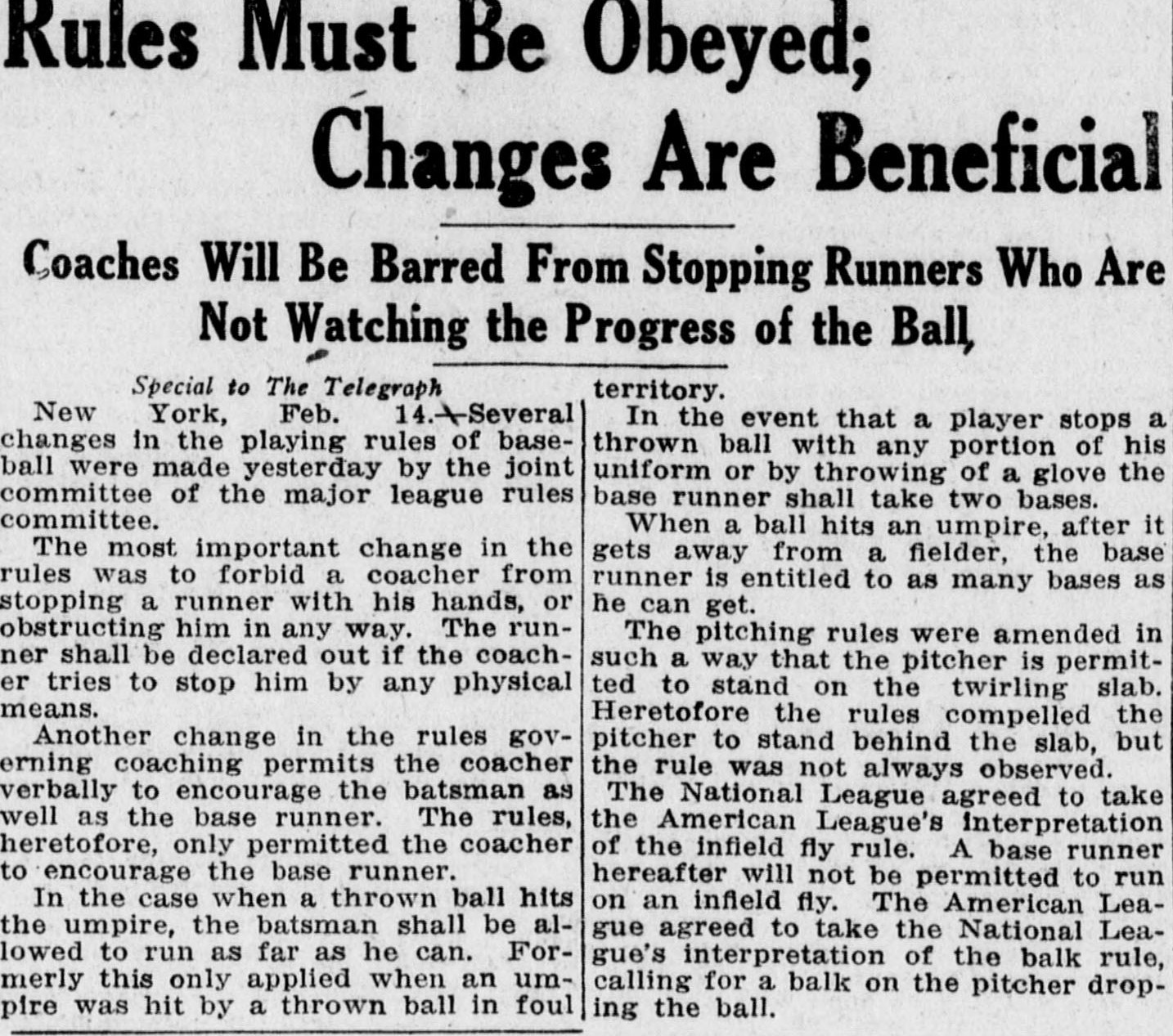
February 1914: the joint rules committee decrees that a coacher may no longer grab his own base runner, that stopping a ball with a thrown glove costs two bases, and that the pitcher may at last legally stand on the slab he was already standing on.
Every February the game gets improved, and February 1914 was a vintage year. The headline lays down the law, “Rules Must Be Obeyed,” and the subhead delivers the year’s marquee reform: “Coaches Will Be Barred From Stopping Runners Who Are Not Watching the Progress of the Ball.”
Picture what this rule implies about 1913. “The most important change in the rules was to forbid a coacher from stopping a runner with his hands, or obstructing him in any way. The runner shall be declared out if the coacher tries to stop him by any physical means.” Until this meeting, a third base coach could evidently tackle his own man on humanitarian grounds. As compensation, the coacher “verbally to encourage the batsman as well as the base runner” became legal. Before 1914 you could only shout at the runner. The batsman stood in silence.
Two more gems. A player who “stops a thrown ball with any portion of his uniform or by throwing of a glove” surrenders two bases, the thrown-glove play apparently being common enough to need a statute. And the pitching rules were amended so “the pitcher is permitted to stand on the twirling slab. Heretofore the rules compelled the pitcher to stand behind the slab, but the rule was not always observed.” A rule everyone ignored, repealed for tidiness in the same breath as a headline that says rules must be obeyed. Somewhere an umpire read this over breakfast and laughed until his coffee went cold.
| Place | Harrisburg, Pennsylvania |
|---|---|
| Year | 1914 |
| Newspaper | Harrisburg Telegraph |
| Posted | |
| Tags |